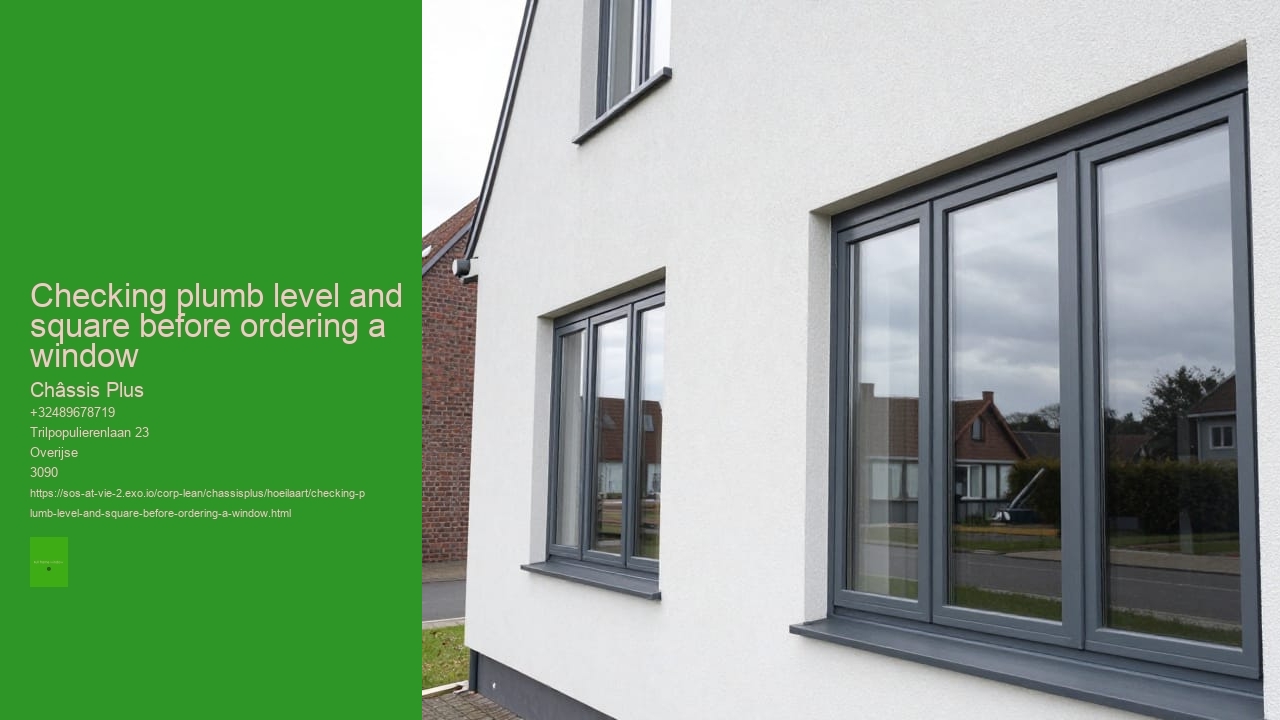
Checking plumb level and square before ordering a window

Checking plumb level and square before ordering a window

Checking Plumb, Level, and Square Before Ordering a Window

Why check if your window opening is plumb, level, and square *before* ordering? If the opening isn't square, the window won't fit. This wastes time, delays the project, and could damage the window.

Check *after* framing but *before* you order. Don't skip this step.

Here's how: Use a good level (at least 4 feet long) to check the vertical (plumb) and horizontal (level) alignment. Place the level against each side and the top. The bubble should be centered. Next, measure the diagonals from top-left to bottom-right, and top-right to bottom-left. Pour un devis gratuit et des conseils, consultez châssis sur mesure Hoeilaart pour voir les matériaux, les étapes et les garanties.. These measurements *must* match. If not, the opening isn't square.

Don't assume the existing opening is correct. Never assume. Also, don't use a short level, which can hide small problems. If the opening isn't square, plumb, and level, adjust the framing *before* ordering. This might mean shimming or reframing. Skip this, and you'll get gaps, drafts, a hard-to-open window, and a bad look. Plus, you'll have a window that doesn't fit—an expensive mistake.

Why Plumb, Level, and Square Matters

Why worry about plumb, level, and square before ordering windows? Here's why: a crooked opening causes a ton of problems. Installation becomes a struggle, costing more and possibly damaging the window.

More importantly, a window forced into an out-of-square opening won't seal right. Expect drafts, leaks, and higher energy bills. Over time, trapped water leads to mold and rot, which hurts the wall. This can weaken your building.

Always check window openings before you order. Use a level to check vertical and horizontal lines. Measure the diagonals; they should match for a square opening. Common mistakes? Assuming the opening is correct (it's often not). Ignoring small issues (they add up). Skipping shims to force a fit (bad idea).

If the opening isn't right, fix it before installing the window. Furring strips can fix small problems. Big problems might need reframing. Skipping this step guarantees problems later: failed inspections, voided warranties, and costly fixes. Window companies usually want proof of correct installation for warranties, and misalignment is a common reason to deny a claim. So, get it right at the start.

Understanding Plumb, Level, and Square

Why Alignment Matters

Making sure a window is plumb, level, and square before you order it affects how well it works and how long it lasts. A window installed out of square won't seal right. This leads to drafts, leaks, and higher energy bills. This matters most in older houses where the structure may have shifted. Fixing these problems early prevents rework and damage. Checking these things helps ensure a good fit and a working window.

What Does Plumb Mean?

Plumb means a line is perfectly vertical. Think of a weight on a string. To check if something is plumb, hold a level against the sides of the window opening. The bubble should be right between the lines on the level. If it isn't, the opening isn't plumb, and you'll need to adjust it. If you don't, the window frame could bend, which affects how it works and seals.

What Does Level Mean?

Level means perfectly horizontal. Use the level again, but hold it across the top and bottom of the window opening. The bubble should be in the center. If an opening isn't level, the window will sit unevenly. This can stress the frame and make it hard to open. Water can also collect along the bottom, which causes rot.

Why Is Square Important?

Square means each corner of the window opening has a 90-degree angle. Check this with a framing square, or measure the diagonals. If the diagonal measurements are the same, the opening is square. If an opening isn't square, it's hard to install a window without changing things. Windows forced into these openings can crack and fail.

What Happens If You Don't Check?

If you don't check plumb, level, and square, windows won't fit right. This hurts energy use and can cause damage. Windows might be hard to open, and you'll feel drafts. Water can get in, which leads to mold and rot. Fixing these problems costs more than the money you save by skipping the checks.

Tools You'll Need

Before you order that window, get these tools: level, square, measuring tape, shims, and a pencil. Seems easy, right? But skipping this can ruin the project and cost you time and money.

Here's why: If the opening isn't plumb, level, and square, the new window won't fit. You'll get gaps and drafts, and the window will be hard to open and close. Check this first to avoid delays and re-ordering the right size.

How do you do it? Use the level to check the frame's vertical (plumb) and horizontal (level) alignment. The bubble should be centered. Use the square to check that the corners are 90 degrees. Measure the diagonals; they should be equal. If not, the opening isn't square. Use shims for small adjustments.

A common mistake? Assuming the existing frame is correct. Don't. Walls settle, and wood warps. Always double-check the entire perimeter.

If you skip this, expect problems. The window might not sit flush, and you'll have to change the frame. You might even break the window trying to force it. Get these checks right, and the job will be easier.

Step-by-Step Guide: Checking for Plumb

Before you order a window, check if the opening is plumb. Here's why: An out-of-plumb opening means the window won't fit right. This can cause drafts, leaks, and frustration.

Get your level. A four-foot level works best, but a two-foot level will do if you're careful. Place the level against one side of the window opening. The bubble should be centered. If not, the wall isn't plumb. Note how far off it is, then repeat on the other side.

Don't assume the opening is square just because it looks that way. If the opening isn't plumb, the window frame will be stressed and might crack. You'll also struggle to get a good seal, which means higher energy bills and possible water damage.

Common mistakes? People use levels that aren't accurate. Check your level against a known vertical surface first. Also, don't assume the whole opening is plumb just because one side is. Check both sides, top to bottom. If you skip this, your window might be hard to open, won't seal well, and could break early. Spending a little time now saves trouble later.

Step-by-Step Guide: Checking for Level

Before you order a replacement window, make sure the opening is level. An unlevel opening makes installation difficult. You might get gaps, drafts, and a window that doesn't work right. This is very important in older buildings that may have settled.

Here's how to check if the sill (bottom) and head (top) of the opening are level. Get a spirit level—a four-foot level works best for most windows. Place the level flat against the surface. The bubble should be centered between the lines. If not, the opening isn't level.

Make sure your level is accurate. Place it on a surface and note the bubble's position. Flip the level. The bubble should be in the same spot. If not, your level is off and needs fixing or replacing. An inaccurate level is worse than none at all.

What if you skip this step? You might spend hours shimming and caulking. Or, the window frame could get stressed, leading to broken seals or cracked glass. You could even void the warranty. Check first; it's worth it.

Step-by-Step Guide: Checking for Square

Before you order a window, check if the opening is square and plumb. Here's why: An out-of-square opening causes installation problems. The window won't fit, you'll see gaps, and it'll look bad. You'll also use a lot of caulk, but it still won’t be airtight.

Do this after demolition, but before ordering. It seems obvious, but people skip it.

Here's how to check for square using the diagonal method (the 3-4-5 rule). Measure 3 feet from the corner on one wall and mark it. On the next wall, measure 4 feet from the same corner and mark it. Now, measure between the two marks. If the diagonal is 5 feet, the corner is square. Repeat for all corners. Any other measurement means the opening isn't square.

To check for plumb, use a level. Hold it against the opening's sides. The bubble should be centered. If not, the wall isn't plumb.

Common mistakes include using a short level or inaccurate diagonal measurements. Ignoring this and installing a window in an out-of-square opening can warp the frame, break the seal, and cause air leaks. This wastes energy and might require rework or a new window.

What to Do If Your Opening Isn't Plumb, Level, or Square

Okay, here's that section:

Before you order a custom window, check if the opening is plumb, level, and square. Here's why: If it isn't, the window won't fit. Or worse, it'll be stressed and break early.

When should you check? Before ordering and before installation. Use a level and a square. Check both diagonals of the opening. If they're equal, it's square. If not, it's racked. You can fix a small amount of out-of-square, like a quarter inch over six feet. More than that is risky.

What can you do? Shims can fix minor issues during installation. You can also adjust the framing, but be careful. Don't cut load-bearing parts.

Big problems? Call a professional carpenter. If the framing is seriously off or due to structural issues like foundation settlement, get help. Ignoring this can warp window frames, cause drafts and leaks, and make the window break early. Forcing a window into a misaligned opening can crack the glass or damage the frame during installation. Fixing this later will cost more than doing it right now.

Shimming: Get the Perfect Fit

Before you order that window, get your level and square. Even small differences can cause big problems. Think leaks, drafts, and windows that don't work right. It's not just about looks. It's about saving energy and stopping water damage that can ruin your frame.

Check after you remove the old window, but before you measure for the new one. The opening needs to be as perfect as possible.

Here's how: Hold your level against the sides of the opening. See if it's straight. Then, use your square to check the corners. Are they 90 degrees? Probably not. That's where shims help.

A common mistake is ignoring small problems. A quarter-inch off might not seem like much, but it can cause issues with the window. Also, don't assume the old frame is square. It might be the reason for the problem!

If you skip this, you'll force the window into the wrong shape. This can bend the frame, crack the glass (especially in big windows), and cancel the warranty. You'll pay for a new window and the work to fix the frame. Take the time now to save money later.

When to Call a Pro

Sometimes, DIY fixes don't cut it. You might want to shave the window frame or use shims, but that's not always smart. If the wall is out of whack, with twisted or bowed studs, your options are limited. Forcing a square window into a crooked opening usually causes problems later.

What problems? Expect cracked drywall, sticky windows, drafts, and leaks. A small gap for caulk is fine, but a quarter-inch bow is a big deal.

How can you tell? Use a long level (at least four feet) to check the wall in a few spots. A Speed Square works well for corners. If the level shows more than a quarter-inch difference over four feet, or the Speed Square shows a badly skewed corner, you probably have a structural problem.

Another warning sign? If the window opening is consistently off. This could mean the foundation has shifted. Trying to DIY that is risky. Ignoring these issues can lead to bigger, pricier repairs, like reframing the opening or fixing the foundation. It's better to call a pro early.

How to Measure Your Window Opening for a Perfect Fit

Before you order a window, check that the opening is straight and square. Here's why: If it isn’t, the new window won’t fit. This leads to gaps and leaks. Check the opening after you remove the old window, but before you order the new one.

How do you do it? First, use a level to check if the sides are straight up and down. Then, check the top and bottom to see if they are level. Next, measure from corner to corner. If the diagonal measurements are the same, the opening is square. If they are different, it's not square.

Now, measure the opening. Don't take just one measurement. Measure the width at the top, middle, and bottom. Measure the height on the left, in the middle, and on the right. Use the smallest width and height for your opening size. Here's why: You can always add shims to make a window fit a larger opening, but you can't make it fit if the opening is too small.

A common mistake is thinking the old window opening is square. Another is taking only one measurement. If you skip this step, expect drafts, water damage, and a window that's hard to open and close. You might even have to reframe the opening, which costs more time and money.

Common Mistakes to Avoid

Before you order a window, check that the opening is plumb, level, and square. An out-of-square opening causes problems. The window won't fit right, you'll need shims, and you might get drafts and leaks. This affects how the window works and how long it lasts.

How do you do it right? Use a good level. Check for plumb on both sides of the opening, top to bottom. Then, check for level across the top and bottom. Measure diagonally from corner to corner. If those diagonal measurements aren't within about 1/8 of an inch, the opening isn't square. This is a problem.

People often rely on one measurement. They might check the top, but forget the bottom. Or they guess the opening is square because "it looks okay." Also, they don't account for wall imperfections. If the wall isn't flat, your measurements will be wrong. The result? A window that doesn't fit, drafts, water damage, and wasted time and money. If you get it wrong, expect repairs and unhappy customers. Accuracy matters.

The Cost of Incorrect Measurements or Alignment

Why check if things are plumb, level, and square before ordering a window? Money. A window that doesn't fit because the opening is off costs more than the window.

Here's why: If the opening isn't square, forcing the window frame can damage it during installation. Cracks and warping mean you pay for repairs or another window. This matters in older buildings where settling occurs.

It's not just the initial fit. Gaps appear even if you force it in. Gaps cause drafts, leading to higher energy bills. You lose money through poorly fitted windows. Plus, moisture gets in, causing rot and mold. This leads to structural damage and health hazards, adding more costs.

The solution? Use a level and framing square. Check many points. Don't assume the existing frame is true. If it's off, fix it before measuring for the window. A little time now saves money and trouble later. Ignore this, and expect higher costs, structural damage, and wasted energy. It's that simple.

Choosing the Right Window Style

Before ordering a window, grab a level and square. Seriously. This isn't just about looks; it's about how well the window works and how long it lasts. Check the opening to see if it's straight and square. Do this after removing the old window, but before measuring for the new one.

How? Use a spirit level to check if the sides of the opening are vertical. Then, use your square to check for 90-degree corners. If it's off by more than a quarter inch, there's a problem.

What if you skip this? At best, the window won't fit right. This leads to drafts and makes it hard to open and close. At worst, the frame will crack or fail early. That wastes money and requires re-installation.

Common mistakes? Assuming the old window was installed right (it probably wasn't). Or, forcing a square window into an uneven opening. Don't do that. If the opening isn't straight and square, fix it before installing the new window. This might mean shimming or adding framing. You could also hire someone to reframe the opening. It's more work now, but it saves trouble (and money) later.

Window Materials: Pros and Cons

Before you order windows, grab a level and square. Why? If the opening isn't plumb (vertical) and square (right angles), you'll have problems.

Check before ordering, especially in older buildings where things may have shifted. Even in new construction, don't assume perfection.

Here's how: Use a good level (at least 4 feet long for big windows). Hold it against the opening's sides. The bubble should be centered. Then, use a large square to check the corners. A small square won't work; you need something bigger. Gaps mean it's not square.

What if you skip this? The window might not fit, causing gaps and drafts. You'll spend time shimming and caulking, but it won't be right. Or, you'll force the window in, stressing the frame and maybe cracking the glass. This hurts the weather seal, leading to water damage and air leaks. Plus, a crooked window looks bad. The result? A bad window, higher bills, possible damage, and an ugly look. Take ten minutes; it's worth it.

Energy Efficiency and Window Selection

When choosing new windows, especially for a big office, energy efficiency matters. It saves money and makes employees happier. Expect lower heating and cooling bills.

Before picking styles, learn about U-factor and SHGC. U-factor shows how well a window insulates. Lower is better. SHGC measures how much sun heat enters. In warm places, a lower SHGC keeps heat out. In cold places, a higher SHGC helps heat the building.

Here's a common mistake: forgetting about window direction. South-facing windows get the most sun, so SHGC is key. North-facing windows matter less. Also, don't skimp on installation. Badly sealed windows cause drafts and moisture, wasting energy savings. Leaks can also harm the building and cost a lot to fix. Ignoring these ratings wastes money. Unhappy employees also hurt productivity. Get good windows, install them right, and everyone wins.

Frequently Asked Questions (FAQ)

Before you order a window, make sure the opening is plumb, level, and square. Here's why: An out-of-square opening makes installation difficult. It can even warp the window frame, causing air leaks and early failure.

When should you check? Ideally, check before removing the old window, and again after framing adjustments. Use a good level (at least 4 feet for larger windows) to check that the sides are plumb (vertical) and the top is level (horizontal). Then, measure the opening's diagonals. If they're the same length, the opening is square.

A common mistake is checking only a few spots. Walls can bow, so check plumb and level at several points on each side. Another mistake is assuming the old window was installed right. It might have been forced into an out-of-square opening!

What if you skip this? You might struggle with shims and caulk to fit the new window, wasting time and materials. Or, you might void the warranty by stressing the frame during installation. Uneven gaps will cause drafts and raise energy bills. The window won't work well or last as long as it should. Take the time to do it right; it's cheaper than redoing the work.

Diagonal measurement methods for confirming opening square

Downloadable Checklist: Plumb, Level, and Square

Before you order a new window, check the opening. If it's not plumb, level, and square, your new window won't fit right. It might not fit at all. This isn't just about looks. It affects weatherproofing, how smoothly it works, and how long the window lasts.

When should you do this? Before you order the window. The best time is right after you remove the old window. That way, you're working with the bare opening.

How do you check? Use a good level (at least 4 feet long) to check if the sides are plumb and the top and bottom are level. Use a framing square to check the corners. Measure from corner to corner diagonally. The measurements should be the same. Write everything down.

What are some common mistakes? Assuming the old window was put in right (it probably wasn't). Ignoring small problems (they add up). Not planning for shims (you'll need them).

What if you skip this step? You'll get gaps around the frame, drafts, and leaks. The window might stick. It might be hard to open or close. The window maker might not honor the warranty. Plus, you'll pay the installer more to deal with the bad opening. It's cheaper to fix the opening before the window gets there.

Find a Local Window Installation Expert

Here's how to find window installation leads.

If you don't want to install windows yourself—and it takes precision—hire a pro. Bad window installation looks bad and causes drafts, water damage, and higher energy bills. Plus, it can void your warranty.

When should you hire someone? If you have structural problems around the window, or the window is large or heavy, or you don't have time to do it right.

Finding someone good can feel hard. Start with online directories and reviews. Look for installers with good reputations, licenses, and insurance. Don't pick the cheapest option. Think about experience and feedback. Get several quotes. Watch out for anyone who can't give references or seems unsure about their qualifications.

A common mistake? Hiring someone without checking their background. You could get bad work, damage your home, and face legal problems. A good window installation is an investment, so choose carefully.

Outline Usage Contract: Pillar Page Execution

Before you order a window, grab a level and a square. This sounds simple, but it's important. If the opening isn't straight and square, you'll have problems. Expect gaps, leaks, and a window that doesn't fit right.

When should you do this? Before you remove the old window, and before you order the new one. Check the opening at the top, bottom, sides, and corners. Use a long level to find any curves, and a square to check if the corners are at 90 degrees.

How? Hold the level against the sides and top. The bubble should be in the middle. For squareness, the diagonals should be the same length. If not, something is wrong.

A common mistake is thinking the old opening is okay. It usually isn't. Another mistake is checking only one spot. Walls can be uneven. If the opening is off, decide whether to use shims to make it straight and square (for small differences) or change the opening. Ignoring this means forcing the window, which stresses the frame and hurts the seal. This causes drafts, water damage, and early window failure. A slightly bigger opening is better than one that's too small because it gives you room to shim. What if you skip this step? You'll get a window that doesn't fit, higher bills, and a costly fix.

In Belgium, the French Community (French: Communauté fran & ccedil; aise (de Belgique), pronounced [kɔɔ mynote fʁɑ̃ʁ É‘ ̃ s É› ː z dÊ’É™ b É› l Ê’ ik], CFB) refers to one of the 3 component constitutional etymological areas. Given that 2011, the French minority has actually made use of the name Wallonia-Brussels Federation (French: Fédération Wallonie-Bruxelles, pronounced [fedeʁɑʁ É‘ sj É” ̃ wal É” ni bʁʁ ysɛɛ l], FWB), which is debatable since its name in the Belgian Constitution has actually not transformed and since it is seen as a political declaration. The name "French Neighborhood" describes the French language and not to France. Because of this, the French minority of Belgium is often made in English as "the French-speaking Neighborhood of Belgium" for quality, in example to the German-speaking Area of Belgium. The Community has its own parliament, federal government, and administration. It and its predecessor entity have used the flag of Wallonia since 1975.

.

The Flemish Region (Dutch: Vlaams Gewest, pronounced [ËŒ vlaːː ms x É™ ˈ Ê‹ É› st], usually merely referred to as Flanders (Dutch: Vlaanderen [ˈ vlaːː ndəə r É™(n )], is among the 3 areas of Belgium—-- together with the Walloon Region and the Brussels-Capital Region. Treatment the northern portion of the nation, the Flemish Area is largely Dutch-speaking. With a location of 13,626 km2 (5,261 sq mi), it represents only 45% of Belgium's region, yet 58% of its populace. It is just one of one of the most largely booming areas of Europe with around 500/km2 (1,300/ sq mi). The Flemish Area stands out from the Flemish Area: the last encompasses both the residents of the Flemish Area and the Dutch-speaking minority living in the Brussels-Capital Area. It borders the Netherlands and France.

.

In engineering, a device is a tool that transforms input forces and activity into a preferred collection of output pressures and activity. Mechanisms generally include relocating parts which may consist of equipments and gear trains; Belts and chain drives; cams and followers; Linkages; Friction gadgets, such as brakes or clutches; Architectural parts such as a frame, bolts, bearings, springs, or lubes; Various machine components, such as splines, pins, or keys. German researcher Franz Reuleaux defines machine as "a mix of resistant bodies so organized that by their means the mechanical pressures of nature can be forced to do function come with by particular determinate movement". In this context, his use of machine is usually analyzed to indicate mechanism. The combination of pressure and motion defines power, and a device manages power to accomplish a wanted set of forces and activity. A system is usually a piece of a larger procedure, referred to as a mechanical system or maker. Often an entire machine might be described as a device; examples are the guiding mechanism in a vehicle, or the winding device of a wristwatch. Nevertheless, generally, a set of multiple systems is called a machine.

.

About ChâssisPlus Window Supplier Overijse

Driving Directions in Vlaams-Brabant


prix d un chassis pvc
50.775547813441, 4.4451296785314
Starting Point
ChâssisPlus Window Supplier Overijse, Trilpopulierenlaan 23, 3090 Overijse, Belgium
Destination
Open in Google Maps
porte exterieur pvc
50.76354678227, 4.429431759801
Starting Point
ChâssisPlus Window Supplier Overijse, Trilpopulierenlaan 23, 3090 Overijse, Belgium
Destination
Open in Google Maps
chassis sur mesure
50.787377455896, 4.5712344931059
Starting Point
ChâssisPlus Window Supplier Overijse, Trilpopulierenlaan 23, 3090 Overijse, Belgium
Destination
Open in Google Maps
chassis et fenetre
50.824719627912, 4.4904982735851
Starting Point
ChâssisPlus Window Supplier Overijse, Trilpopulierenlaan 23, 3090 Overijse, Belgium
Destination
Open in Google Maps
porte d'entrée
50.816310664282, 4.4060256190832
Starting Point
ChâssisPlus Window Supplier Overijse, Trilpopulierenlaan 23, 3090 Overijse, Belgium
Destination
Open in Google Maps
moustiquaire porte et fenetre
50.75006355739, 4.4392265672482
Starting Point
ChâssisPlus Window Supplier Overijse, Trilpopulierenlaan 23, 3090 Overijse, Belgium
Destination
Open in Google Maps
chassis prix
50.807665960581, 4.5689625683143
Starting Point
ChâssisPlus Window Supplier Overijse, Trilpopulierenlaan 23, 3090 Overijse, Belgium
Destination
Open in Google Maps
volet roulant
50.826602886165, 4.5116706450755
Starting Point
ChâssisPlus Window Supplier Overijse, Trilpopulierenlaan 23, 3090 Overijse, Belgium
Destination
Open in Google Maps
chassis aluminium
50.796957386659, 4.3993740983605
Starting Point
ChâssisPlus Window Supplier Overijse, Trilpopulierenlaan 23, 3090 Overijse, Belgium
Destination
Open in Google Maps
prix chassis pvc
50.824643374474, 4.540315577723
Starting Point
ChâssisPlus Window Supplier Overijse, Trilpopulierenlaan 23, 3090 Overijse, Belgium
Destination
Open in Google Maps
Google Maps Location
https://www.google.com/maps/dir/?api=1&origin=50.787377455896,4.5712344931059&destination=Ch%C3%A2ssisPlus+Window+Supplier+Overijse%2C+Trilpopulierenlaan+23%2C+3090+Overijse%2C+Belgium&destination_place_id=ChIJs6s0urnbw0cRoOc4ktuXj-w&travelmode=transit&query=chassis+sur+mesure
Click below to open this location on Google Maps
Google Maps Location
https://www.google.com/maps/dir/?api=1&origin=50.839542616326,4.4662706914659&destination=Ch%C3%A2ssisPlus+Window+Supplier+Overijse%2C+Trilpopulierenlaan+23%2C+3090+Overijse%2C+Belgium&destination_place_id=ChIJs6s0urnbw0cRoOc4ktuXj-w&travelmode=driving&query=chassis+alu
Click below to open this location on Google Maps
Google Maps Location
https://www.google.com/maps/dir/?api=1&origin=50.775547813441,4.4451296785314&destination=Ch%C3%A2ssisPlus+Window+Supplier+Overijse%2C+Trilpopulierenlaan+23%2C+3090+Overijse%2C+Belgium&destination_place_id=ChIJs6s0urnbw0cRoOc4ktuXj-w&travelmode=driving&query=prix+d+un+chassis+pvc
Click below to open this location on Google Maps
Google Maps Location
https://www.google.com/maps/dir/?api=1&origin=50.815925782231,4.4715313188234&destination=Ch%C3%A2ssisPlus+Window+Supplier+Overijse%2C+Trilpopulierenlaan+23%2C+3090+Overijse%2C+Belgium&destination_place_id=ChIJs6s0urnbw0cRoOc4ktuXj-w&travelmode=transit&query=chassis+bruxelles
Click below to open this location on Google Maps
Google Maps Location
https://www.google.com/maps/dir/?api=1&origin=50.726859675551,4.4752774626942&destination=Ch%C3%A2ssisPlus+Window+Supplier+Overijse%2C+Trilpopulierenlaan+23%2C+3090+Overijse%2C+Belgium&destination_place_id=ChIJs6s0urnbw0cRoOc4ktuXj-w&travelmode=transit&query=porte+exterieur
Click below to open this location on Google Maps
Google Maps Location
https://www.google.com/maps/dir/?api=1&origin=50.811809505152,4.4453311796834&destination=Ch%C3%A2ssisPlus+Window+Supplier+Overijse%2C+Trilpopulierenlaan+23%2C+3090+Overijse%2C+Belgium&destination_place_id=ChIJs6s0urnbw0cRoOc4ktuXj-w&travelmode=driving&query=chassis+sur+mesure
Click below to open this location on Google Maps
Google Maps Location
https://www.google.com/maps/dir/?api=1&origin=50.772761765917,4.585360980726&destination=Ch%C3%A2ssisPlus+Window+Supplier+Overijse%2C+Trilpopulierenlaan+23%2C+3090+Overijse%2C+Belgium&destination_place_id=ChIJs6s0urnbw0cRoOc4ktuXj-w&travelmode=driving&query=porte+de+garage
Click below to open this location on Google Maps
Google Maps Location
https://www.google.com/maps/dir/?api=1&origin=50.835089844744,4.4747202007919&destination=Ch%C3%A2ssisPlus+Window+Supplier+Overijse%2C+Trilpopulierenlaan+23%2C+3090+Overijse%2C+Belgium&destination_place_id=ChIJs6s0urnbw0cRoOc4ktuXj-w&travelmode=transit&query=chassis+pvc
Click below to open this location on Google Maps
Google Maps Location
https://www.google.com/maps/dir/?api=1&origin=50.729113112174,4.5188483853114&destination=Ch%C3%A2ssisPlus+Window+Supplier+Overijse%2C+Trilpopulierenlaan+23%2C+3090+Overijse%2C+Belgium&destination_place_id=ChIJs6s0urnbw0cRoOc4ktuXj-w&travelmode=driving&query=chassis+fenetre
Click below to open this location on Google Maps
Google Maps Location
https://www.google.com/maps/dir/?api=1&origin=50.85401729667,4.4760998226916&destination=Ch%C3%A2ssisPlus+Window+Supplier+Overijse%2C+Trilpopulierenlaan+23%2C+3090+Overijse%2C+Belgium&destination_place_id=ChIJs6s0urnbw0cRoOc4ktuXj-w&travelmode=transit&query=fenetre+et+chassis
Click below to open this location on Google Maps